
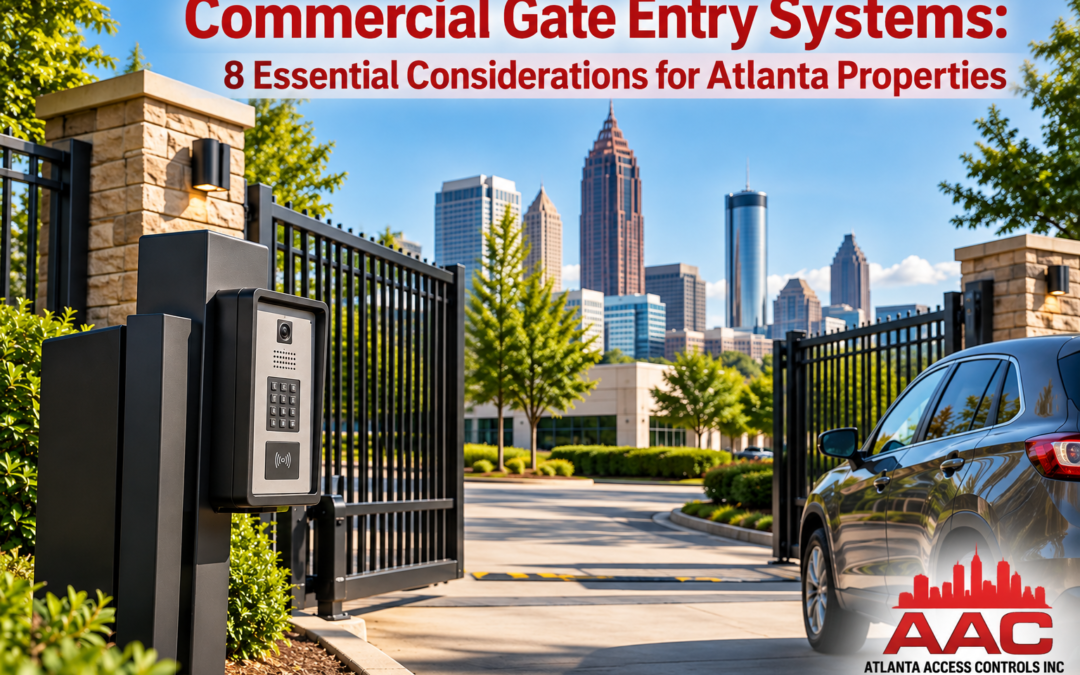
Commercial Gate Entry Systems do much more than open and close a gate. For Atlanta businesses, industrial facilities, multifamily properties, parking areas, and other controlled sites, a properly planned gate entry system must coordinate the physical gate and operator with access control, vehicle detection, visitor entry, safety devices, communications, and the way people actually enter and leave the property.
That distinction is important because a gate operator by itself does not determine who should enter. The operator provides the mechanical movement that opens and closes the gate. The access control and entry system determines how authorized employees, residents, vendors, visitors, and other users request or receive access.
A successful commercial gate project therefore begins with the complete entry process rather than with a single piece of equipment. How many vehicles use the entrance? Is the gate intended for employees, residents, visitors, deliveries, or a combination of users? Will credentials be issued? Do visitors need to communicate with someone inside the property? Does the organization want video verification? How will the gate behave during high-traffic periods or when service is required?
Atlanta Access Controls designs and services commercial access control and gate-entry solutions throughout Metro Atlanta and North-Central Georgia. This guide examines eight considerations that can help property owners and managers plan a gate system around the operational requirements of the site rather than selecting equipment before those requirements are understood.
Table of Contents
- What Makes a Commercial Gate Entry System Complete?
- 1. Match the Gate Operator to the Entrance
- 2. Choose the Right Access Control Method
- 3. Plan Vehicle Detection and Traffic Flow
- 4. Provide a Practical Visitor Entry Method
- 5. Address Gate Safety and Entrapment Protection
- 6. Consider Video Surveillance and Entry Verification
- 7. Evaluate Power, Communications and Site Conditions
- 8. Plan for Service, Reliability and Future Expansion
- Connecting the Gate to the Larger Access Control System
- Planning Commercial Gate Entry Systems With Atlanta Access Controls
What Makes Commercial Gate Entry Systems Complete?
A commercial gate entrance is best understood as a collection of coordinated components rather than a single product.
The physical gate creates the controlled opening. The gate operator moves it. Access control determines whether an individual or credential is authorized. Readers, keypads, mobile credentials, vehicle credentials, intercoms, or other entry devices provide ways for users to request access. Vehicle-detection equipment can help the system respond to approaching or departing vehicles, while safety devices address hazards associated with a moving gate.
Depending on the property, cameras may provide additional visibility at the entrance, and an intercom or video entry system may allow staff to communicate with visitors before granting access. Power, network or communications infrastructure, emergency procedures, and ongoing service requirements also affect how reliably the entrance operates.
The pieces have to work together.
For example, installing a powerful gate operator does not solve the entry problem if employees regularly struggle with the credential method. Adding a sophisticated reader does not correct poor traffic flow. A visitor intercom can become frustrating if vehicles cannot stop in a practical location to use it. And an otherwise well-designed access control system can still create operational problems if the gate equipment is not appropriate for the size, weight, construction, and usage of the entrance.
This is one reason gate projects benefit from being planned as part of the property’s overall access-control strategy. Atlanta Access Controls’ Access Control Systems Atlanta guide provides a broader look at credentials, system management, integration, gates, and other considerations involved in controlling access to commercial properties.
The first planning step for the gate itself is understanding exactly what must move and how frequently it must move.
1. Match the Gate Operator to the Entrance
The gate operator is the mechanical heart of an automated gate system, but selecting one should begin with the physical entrance rather than with a preferred operator model.
Commercial gates vary considerably. A property may use a sliding gate that travels horizontally along the entrance, a swinging gate that rotates inward or outward, or another configuration designed around the available space and site conditions. The gate’s dimensions, weight, construction, travel requirements, and expected cycle frequency all affect operator selection.
Traffic volume matters as well. An entrance serving a small office property may operate far less frequently than a gate controlling employee traffic at a distribution facility, multifamily community, parking area, or busy industrial site. Equipment should be selected for the actual operating demands of the property rather than simply because it can physically move the gate.
Site layout can also influence the decision. A swing gate requires appropriate clearance for its movement. A slide gate requires sufficient room for the gate to travel beside the opening. Grade, drainage, curbs, landscaping, fencing, vehicle stacking space, and the location of nearby equipment can all affect the finished design.
Existing gate systems deserve the same kind of assessment. A property experiencing recurring problems does not necessarily need every component replaced. The gate, operator, controls, access devices, safety equipment, power, and communications should be evaluated individually to determine where the actual limitation exists.
In some cases, an older operator may no longer fit the property’s traffic demands or service requirements. In others, the operator may remain usable while the access-control or visitor-entry portion of the system needs modernization.
This distinction is particularly important when a property owner says, “We need a new gate system.” The real requirement may be a new operator, a better credential method, improved visitor management, updated safety equipment, integration with access control, or a combination of those improvements.
A site assessment helps separate those needs before equipment is selected.
2. Choose the Right Access Control Method
Once the gate can be operated reliably, the next question is who should be allowed to activate it and how that authorization should occur.
Commercial properties have several potential access methods. Employees or residents may use cards, fobs, mobile credentials, PINs, or other supported credentials. Some properties may use vehicle-oriented credentials or identification technologies where the application and selected platform support them. Visitors may require an entirely different entry process.
The correct method depends heavily on the user population.
An employee entrance serving a relatively stable workforce has different requirements from an apartment community with residents, guests, delivery drivers, contractors, and property personnel. A warehouse may need to distinguish employees from commercial vehicles. A gated office property may need convenient daily access for staff while still providing controlled visitor entry during business hours.
Credential management should therefore be considered before the reader or keypad is selected. Someone must issue credentials, remove access when a user leaves, establish schedules, manage lost credentials, and determine which people are permitted to use particular entrances.
Connecting the gate to a commercial access control platform can make those permissions part of the same administrative environment used for controlled building doors. Instead of treating the vehicle entrance as an isolated device, the organization may be able to manage gate access according to the same broader security policies used throughout the property, depending on the selected system architecture.
Convenience matters, but it should not be the only consideration. A credential method should also fit the environment in which it will be used. Drivers need to approach the entry device safely and conveniently. Reader placement, pedestal height, lane configuration, weather exposure, vehicle type, and the distance from the gate all influence usability.
A method that works well at a pedestrian entrance may be awkward when a driver has to reach through a vehicle window. Likewise, a keypad may be appropriate for one application but create unnecessary credential-sharing concerns in another.
The strongest design balances security with a realistic understanding of how people will use the entrance every day. That becomes even more important when the property must accommodate both regular users and people who arrive without permanent credentials.
3. Plan Vehicle Detection and Traffic Flow
A commercial gate system has to manage vehicles efficiently as well as control access. The way vehicles approach, stop, receive authorization, pass through the opening, and leave the property should therefore be considered as part of the system design.
Vehicle detection can serve several purposes depending on the equipment and application. Detection devices may help identify the presence of a vehicle, support gate operation, assist with exit functions, or contribute to the sequence used to manage traffic through the entrance.
The specific technology should be selected around the site rather than assumed in advance. Vehicle loops, sensors, and other detection methods have different installation and application requirements, and their roles should not be confused with the separate safety devices required for an automated gate system.
Traffic flow is equally important.
A credential reader or intercom may function perfectly and still create a poor entry experience if drivers cannot approach it comfortably. The location of the entry pedestal, distance from the gate, lane width, turning radius, vehicle stacking area, and expected types of vehicles all affect the finished entrance.
A property serving passenger vehicles may have very different requirements from a distribution or industrial facility receiving delivery trucks. Multifamily properties may experience concentrated traffic during particular times of day, while an office or industrial site may have predictable employee shift changes that create short periods of much heavier gate use.
Those traffic patterns can influence more than convenience. If vehicles regularly back up beyond the controlled entrance or drivers have difficulty positioning themselves to use a reader, keypad, or intercom, the entry system may create operational problems for the property.
Exit traffic should be planned separately rather than assumed to work exactly like entry traffic. Some properties may use controlled access for entry while providing a different method for authorized vehicles to leave. The appropriate approach depends on the site’s security requirements, traffic pattern, equipment, and applicable safety requirements.
The objective is a controlled entrance that works with the normal movement of vehicles rather than forcing every driver to compensate for a poorly planned equipment layout.
4. Provide a Practical Visitor Entry Method
Permanent users are usually the easiest people to manage at a commercial gate because the organization can issue them an approved credential. Visitors create a different challenge.
Customers, vendors, contractors, delivery drivers, service personnel, guests, and other temporary users may arrive without a permanent card, fob, mobile credential, or other established means of entry. The gate system needs a practical way to handle them without undermining the purpose of controlling the entrance.
An intercom or video entry system can provide communication between the gate and an authorized person inside the property or at another approved location. Depending on the selected platform, staff may be able to identify the visitor, communicate with that person, and release the gate after determining that entry should be granted.
The design should reflect how the property actually handles visitors.
A small office may simply need visitors to contact a receptionist during business hours. A multifamily community may need residents to interact with guests. An industrial property may need vendors or drivers to communicate with security personnel or another designated employee. A property with frequent deliveries may need an entry process that accommodates commercial drivers without unnecessarily disrupting normal employee traffic.
Placement again matters. A visitor should be able to reach and use the communication equipment without creating an unsafe or awkward vehicle position. Audio quality, camera position where video is used, lighting, signage, lane configuration, and the distance between the entry station and gate can all affect usability.
The organization should also decide who has authority to release the gate. Providing remote release capability does not mean every employee should be able to admit visitors. Entry procedures should reflect the property’s security policies and the responsibilities assigned to the people managing the entrance.
When visitor entry is treated as part of the overall access-control process rather than an afterthought, the gate can remain controlled without creating unnecessary frustration for legitimate visitors.
5. Address Gate Safety and Entrapment Protection
An automated vehicular gate is a large moving system. Safety therefore has to be considered during design, installation, operation, and service rather than added after the access-control equipment has been selected.
Two important industry standards address different aspects of automated vehicular gate systems. ASTM F2200 addresses automated vehicular gate construction, while UL 325 addresses operators and systems, including requirements associated with entrapment protection. The UL Solutions overview of access control and gate operators explains how UL 325 applies to automatic gate operators and how access-control equipment relates to the larger perimeter-security system.
Entrapment protection is particularly important because a moving gate can create areas where a person or object could be caught, struck, pinned, or trapped. The required protection depends on the gate configuration, operator, installation, and identified entrapment zones.
Photoelectric devices, sensing edges, and other approved protection methods may be used as part of an appropriate system design. They should be selected and installed according to the operator manufacturer’s instructions and applicable requirements rather than treated as interchangeable accessories.
The physical gate itself matters as well. Construction, openings, clearances, travel path, hardware, and the surrounding site can affect the hazards associated with an automated entrance. That is one reason a gate operator should not be evaluated independently from the gate it will move.
Pedestrian movement also deserves attention. A vehicular gate is designed to control vehicles, and a property should consider how pedestrians are expected to enter and leave without relying on the vehicle gate as an improvised pedestrian opening.
Existing systems should not be assumed to meet current requirements simply because they continue to operate. When an older gate is being repaired, modernized, or connected to new access-control equipment, the condition and configuration of the gate, operator, and safety devices should be evaluated as part of the project.
Safety requirements can depend on the specific installation and applicable codes and standards. A qualified gate professional should evaluate the actual site and equipment rather than relying on a generalized checklist.
6. Consider Video Surveillance and Entry Verification
Access control answers an important question at a gate: should this credential, code, or authorized request cause the entrance to open?
Video can answer a different question: what is actually happening at the entrance?
A camera positioned around a commercial gate may provide useful visual information about vehicles, visitors, incidents, traffic conditions, or events associated with the entry point. When properly planned, video surveillance can complement gate access control without replacing it.
This distinction matters because a valid credential does not necessarily explain the complete event. A credential may identify the user or account associated with an access request, while video may provide additional context about the vehicle or activity occurring at the entrance.
Video can also support visitor entry. A video intercom or appropriately positioned surveillance camera may help authorized personnel visually assess a visitor before releasing the gate, depending on the system design and operational procedures.
Camera placement should be based on the information the organization actually needs. A wide overview of the entrance serves a different purpose from a view intended to capture activity near an entry pedestal. Lighting, vehicle headlights, weather, mounting position, field of view, network availability, and image requirements should all be considered.
The organization should also determine whether gate events and video need to operate as separate systems or whether integration would provide useful operational benefits. The answer depends on the access-control and video platforms selected and the requirements of the property.
Integration should have a purpose. Connecting systems simply because integration is technically possible can add complexity without improving security or operations. When access-control events and video information together help staff investigate activity, verify entry, or manage the property more effectively, integration can provide meaningful value.
Atlanta Access Controls can evaluate gate entry as part of a broader commercial security system, allowing access control, gate operation, visitor communication, and video surveillance to be considered together rather than as unrelated projects.
7. Evaluate Power, Communications and Site Conditions
A commercial gate entry system depends on infrastructure that may not be obvious when someone first looks at the entrance.
The gate operator requires appropriate power. Access control equipment, readers, intercoms, cameras, vehicle-detection equipment, safety devices, and communications may have their own power and connectivity requirements. The way those components are installed and connected can have a significant effect on the reliability and serviceability of the finished system.
That makes an early site assessment particularly important for a new gate project.
The distance between the gate and the building can influence how power, data, and other communications reach the entrance. Existing conduit may be available at one property but absent or unusable at another. Pavement, landscaping, drainage, underground utilities, fencing, and other site conditions can affect where equipment can be installed and how cabling reaches it.
Network connectivity also deserves careful planning when IP-based access control, video, intercom, or remotely managed equipment is part of the design. A device installed hundreds of feet from the main building should not simply be assumed to have the same communications options as equipment mounted inside the facility.
Where network-connected security equipment is used, the customer’s IT requirements should be considered during design rather than after installation. Addressing network architecture, approved connections, remote-management requirements, and responsibility for maintaining connected devices early in the project can help avoid conflicts later.
Weather exposure is another practical concern. Gate equipment operates outdoors and may be exposed to heat, cold, rain, wind, moisture, lightning, vehicle exhaust, dirt, landscaping activity, and other environmental conditions that indoor access-control equipment does not encounter in the same way.
Power interruptions should also be discussed. The appropriate response to a loss of power depends on the operator, system design, site requirements, emergency procedures, and applicable requirements. Backup power or other provisions may be appropriate for some installations, but those decisions should be based on the actual equipment and operational requirements rather than a generic assumption.
A well-designed gate system accounts for the property surrounding the equipment as carefully as it accounts for the equipment itself.
8. Plan for Service, Reliability and Future Expansion
A gate entrance can quickly become operationally important. When it fails, the problem may affect employees arriving for work, residents entering a property, deliveries reaching a facility, visitors requesting access, or vehicles attempting to leave.
That makes serviceability an important consideration before the system is installed.
Equipment should be selected with attention to the demands of the entrance, manufacturer support, parts availability, maintenance requirements, and the ability of the service provider to diagnose problems across the complete gate system.
This last point matters because a gate problem is not always an operator problem.
A failure may involve the access-control system, credential reader, communications, power, vehicle detection, safety equipment, intercom, wiring, or another component involved in the entry sequence. Troubleshooting becomes easier when the system has been designed and documented as a coordinated installation rather than assembled as unrelated pieces over time.
Preventive maintenance can also be important for heavily used entrances. The physical gate and operator contain moving components, and site conditions can change. Equipment can be damaged by vehicles, weather, landscaping work, construction, or normal wear. A system that operated correctly when installed should still be inspected and serviced according to applicable manufacturer recommendations and site requirements.
Future expansion should be considered at the same time.
A property may eventually add another vehicle entrance, a separate exit lane, additional cameras, new visitor-entry equipment, mobile credentials, another building, or more sophisticated centralized access management. Understanding those possibilities before the initial system is selected can help avoid unnecessary limitations later.
Expansion does not mean purchasing every future component today. It means selecting an architecture that provides a reasonable path toward changes the organization can already anticipate.
This is particularly important for growing commercial and multifamily properties where the first gate may eventually become one controlled opening within a much larger security environment.
Connecting the Gate to the Larger Access Control System
A commercial vehicle gate should not automatically be treated as an isolated security system at the edge of the property.
For many organizations, the gate is actually the first controlled access point a person encounters.
An employee may present a credential at the vehicle entrance before using another credential at the building. A resident may enter through a controlled gate and later use the same access-control environment for another property entrance. A visitor may communicate through an intercom while staff use video to assess the request before authorizing entry.
When appropriate systems are selected, coordinating these functions can provide more consistent administration and a clearer picture of how access is being managed across the property.
The broader principle is straightforward: physical access should be granted according to defined authorization rather than simply because someone reaches an entrance. CISA physical-access guidance includes controlling physical access points and verifying authorization before access is granted. Although specific requirements vary by organization and facility, that principle helps explain why gate entry should be considered part of the property’s overall access-control strategy rather than merely a method for moving a barrier.
Integration can also simplify credential administration. If the selected platform supports the required architecture, an organization may be able to manage permissions for building doors and vehicle entrances through a coordinated access-control environment rather than maintaining completely separate user databases.
That can become particularly useful when someone joins or leaves the organization. Instead of separately changing access at unrelated systems, administrators may have a more consistent method for managing permissions according to the capabilities of the selected platform.
Video surveillance and visitor communication can provide additional context around the entrance, while access-control records can document system events. Those technologies serve different purposes, but thoughtful integration can help authorized personnel manage and investigate activity more effectively.
Integration should still be driven by operational value. Not every property needs every security system connected together, and compatibility should be verified before assuming existing equipment can communicate with a proposed platform.
The objective is a gate entrance that functions as a useful part of the property’s security architecture rather than an isolated piece of automation.
Planning Commercial Gate Entry Systems With Atlanta Access Controls
Commercial Gate Entry Systems work best when the project begins with the property rather than a predetermined list of equipment.
The gate type and operator must fit the physical entrance and expected traffic. The credential method must fit the people using the property. Vehicle detection and lane design should support practical traffic flow. Visitors need an appropriate way to request entry. Safety requirements must be addressed as part of the automated gate system, and power, communications, video, access control, and service requirements all need to work together.
Existing gate systems can benefit from the same approach.
A property experiencing recurring gate problems may not need to replace everything. An assessment can help determine whether the limitation is the physical gate, operator, access-control equipment, visitor-entry method, safety devices, communications, power, or another part of the system.
Atlanta Access Controls works with commercial properties throughout Metro Atlanta and North-Central Georgia to plan, integrate, modernize, and service controlled entry systems. Gate projects can also be evaluated alongside building access control, video surveillance, visitor entry, and other commercial security requirements so that the technologies support the way the property actually operates.
This approach is especially useful for properties where gate reliability has become a recurring problem, where an older operator is being evaluated for replacement, where credential management needs improvement, or where a growing facility wants to connect vehicle entry with a broader access-control platform.
Contact Atlanta Access Controls to discuss your commercial gate entry project and arrange an assessment of the entrance, existing equipment, access requirements, traffic patterns, visitor needs, and future plans.
The goal is not simply to automate a gate. It is to create a commercial entry system that manages vehicles and authorized users reliably while fitting the operational requirements of the property.